




Building Capacity for Climate Action: ECO IGNITE Training at Narratives
Climate change is no longer just a topic for governments and scientists; it is a conversation taking place within organizations of all sizes. Nearly a decade ago, nations from across the globe came together at the 21st United Nations Climate Change Conference (COP 21) to adopt the Paris Agreement. This historic accord committed participants to limiting the global average temperature to well below 2°C above pre-industrial levels, while aiming to pursue efforts to limit warming to below 1.5°C. Canada is a part of this global commitment and has set targets to achieve net-zero emissions by 2050 under the framework of the Canadian Net-Zero Emissions Accountability Act.
So, what does net-zero mean?
Net-zero is the state in which the greenhouse gases released into the atmosphere are balanced by the amount removed from it. Achieving net-zero emissions would mean reducing emissions as much as possible through clean technologies, renewables, and sustainable organizational practices, while addressing the remaining emissions through verified removal methods like carbon offsets. The Paris Agreement has recognized a need for net-zero, and calls for a balance between “anthropogenic emissions by sources and removals by sinks of greenhouse gases in the second half of this century.”
As governments and businesses work towards these milestones, greenhouse gas (GHG) accounting has become an important tool for understanding the environmental impacts of business operations. Across Canada, more companies are moving in the same direction and doing their part. GHG accounting enables organizations to measure emissions associated with their operations and activities, establish a clear baseline, and identify opportunities for improvement.
At Narratives, we believe that taking meaningful climate action comes from within. As an active participant in the United Nations Global Compact, our organization is committed to continually strengthening its sustainability practices. This commitment reflects the shared values of our team, many of whom are passionate about environmental stewardship both professionally and personally.
In alignment with this, Narratives team members recently participated in a hands-on, in-person greenhouse gas accounting training facilitated by ECO Canada through the ECO IGNITE (Innovating GHG-Reduction, Nurturing Institutions, and Training Enterprises) program; the event took place at our head office in Winnipeg. Project IGNITE is designed to support organizations in building the internal knowledge, technical skills, and systems required to advance a low-carbon economy and accelerate the adoption of sustainable practices. Building on the foundational knowledge gained through virtual training completed last year, this hands-on session focused on practical applications of carbon measurement and reporting.

Understanding Greenhouse Gases
To effectively navigate GHG accounting, it is first helpful to understand the greenhouse effect itself. Gases that trap heat within the atmosphere are called greenhouse gases. The greenhouse effect is a natural process where atmospheric gases trap heat from the Sun, helping keep the Earth's surface warm enough to sustain human and ecological life. Without it, the Earth would be too cold to support the ecosystems and communities we depend on daily. However, human activities have significantly increased the concentration of GHGs in the atmosphere. The primary GHGs present in the atmosphere are:
- 1
Carbon dioxide
- 2
Methane
- 3
Nitrous oxide
- 4
Fluorinated gases
Not all greenhouse gases have the same impact on the climate.
While carbon dioxide (CO₂) is the most common greenhouse gas produced by human activities, other compounds trap significantly more heat in the atmosphere than others. For example, methane is released in much smaller quantities than carbon dioxide but has a much stronger warming effect over a shorter period of time. Scientists compare these impacts using a metric called Global Warming Potential (GWP), which measures how much heat a greenhouse gas traps over a given period compared to carbon dioxide. Understanding the difference between these atmospheric impacts is an important part of carbon accounting, helping organizations better understand and manage their environmental footprint.
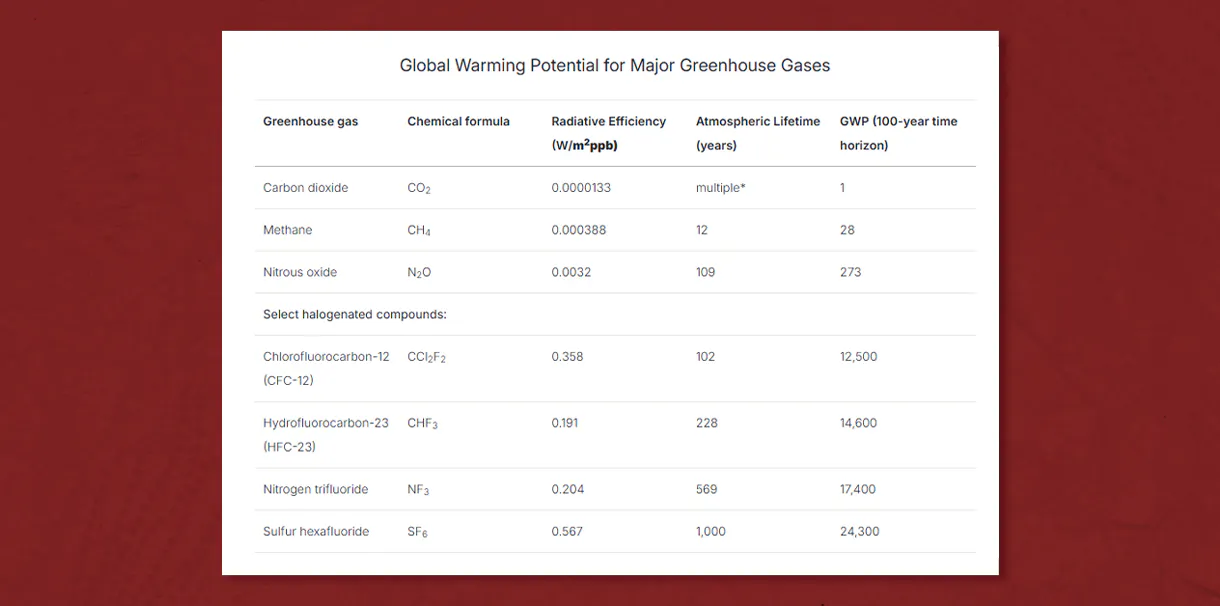
Fig: https://www.c2es.org/content/main-greenhouse-gases/
Understanding Scope Emissions
A key part of GHG accounting is understanding where emissions come from. To support consistent reporting, emissions are typically grouped into three categories, known as scopes.
- 1
Scope 1 (Direct Emissions): Emissions from sources owned and controlled by the company.
- 2
Scope 2 (Indirect GHG Emissions): Emissions associated with purchased electricity or heat used by the organization.
- 3
Scope 3 (Other Indirect Emissions): Emissions that occur as a consequence of the activities of the company, but occur from sources not owned or controlled by the company.
Understanding these scopes helps organizations identify where environmental impacts occur and where opportunities exist to reduce waste and lower overall output.
Learning Through Practical Application
One of the most valuable parts of the workshop was the opportunity to apply all these concepts in a practical setting. Team members conducted a comprehensive office walkthrough to identify potential emission sources, gathering information required for future data collection and analysis. This hands-on exercise helped staff better understand how everyday workplace activities contribute to output and how these impacts can be measured over time.
The training also explored climate science fundamentals, emissions calculation methods, data collection processes, and best practices for maintaining a greenhouse gas inventory over time.
Looking Ahead
Completing the ECO IGNITE training is the beginning of a long journey in the world of meaningful, long-term sustainability. The workshop provided Narratives with a strong starting point for developing a comprehensive GHG inventory and an informed approach to emissions management. The taught foundation will guide the development of the baseline data and create a framework for future data collection and reporting.
As baseline data is collected and analyzed, Narratives will be better positioned to establish emissions reduction targets, identify gaps, discover opportunities for operational improvements, and set realistic targets.
This work goes beyond commitment to sustainability. Understanding and managing GHG emissions can help organizations minimize environmental operational risks while supporting informed decision-making. As Narratives continues this work, future opportunities may also include exploring carbon offsets. Carbon offsets represent real, verified reductions in greenhouse gas emissions that can be purchased to help compensate for emissions that cannot yet be eliminated. While reducing emissions at the source remains the priority, offsets can play a complementary role in a broader emissions management strategy.
The training marked an important step in building Narratives’ internal capacity to measure, manage, and reduce its greenhouse gas emissions. As data is collected and analyzed, Narratives will be better positioned to make informed decisions, improve operational sustainability, and continue building a thoughtful and measurable approach to climate action.