



At both Kahanee and Narratives, we spend a lot of time thinking about stories, which probably isn't surprising.
Kahanee means “story” in Urdu, Punjabi, and Hindi, and as Conor Smith, Partner at Narratives, joked in our second episode of Between the Threads, “We are called Narratives because Story was taken.” So yes, story is pretty deeply rooted in both of us.
But we both approach it from different directions. Kahanee uses story as a tool for peacebuilding, dialogue, connection, and belonging. Narratives weaves story into planning, geographic information systems (GIS), impact assessment, community engagement, and design. There’s a reason why those approaches feel similar: both organizations were founded by Somia Sadiq and grew from a core belief that stories can play an important role in how we understand people, places, ourselves, and one another.
So, when Kahanee decided to start a podcast, naturally we knew Narratives needed to be involved. As someone who has dipped my toes in both organizations, first at Narratives and now at Kahanee, I see the overlap all the time. The perspective is not ‘yours versus mine,’ ‘consulting versus nonprofit,’ or one way of seeing the world versus another. It’s an “and.” Making space for the nuance, the grey, and the story underneath it all.
Now, you might believe making a podcast just means finding guests, checking audio, asking questions, and pressing record. (I think that’s what we originally thought too.) But the microphone isn't really the important part.
The interesting work happens in creating conditions for someone to share something meaningful, for another person to truly listen, and for the people behind the camera or on the other side of the microphone to hold that story with care.
After each unique conversation, here are five insights Kahanee and Narratives have learned, and carry along the way on how to approach each recording session.
1. Ask Questions That Make Room for Stories
When you sit down on a set with lights, cameras, and people watching, you can only be told to “act natural” so many times before you forget how to smile normally. So, on Between the Threads, almost every conversation begins with a simple question: Tell us about younger you.
Before the job title, accomplishments, expertise, or whichever topic brought them to our set, there was a kid figuring things out. And we tend to have a little more compassion for that kid. From there, we ask simple questions that leave room for complicated, real answers. It’s less about “What are your thoughts on X, Y, and Z?” and more about curiosity regarding how someone came to see the world in the way that they do.
That approach and thought process carries across both organizations. The questions we ask shape the stories we hear whether we’re in a podcast studio, community dialogue, or engagement session. Sometimes a good question is all you need to open a door.
2. Consent Can Change When Recording Starts
Agreeing to be on a podcast doesn't mean agreeing to everything. A guest might begin telling a story and realize halfway through that they don't want it shared publicly. They might want to pause, start again, clarify something, or decide afterward that a moment feels too personal.
Consent goes beyond what someone says, too. It can be as simple as respecting that someone has a “good side,” letting them check their hair, or making sure they feel comfortable with how they appear on camera. That matters more than getting the perfect clip.
When people trust us with their experiences, we have a responsibility to remember whose story it is. Consent isn't a single checkbox to cross off before the cameras turn on; it continues throughout the conversation and beyond it.
3. Actually Listen
This one sounds painfully obvious for a podcast, but there is a difference between listening to respond and listening to understand.
We don't prepare a list of expected, surface-level questions ahead of time. We come in with a theme and knowledge of our guest, and we let the conversation take us where it needs to go. Our host is, after all, a trained peace negotiator and facilitator. But there is an openness to it: we follow the threads in our guests’ stories.
That openness is familiar across Narratives and Kahanee: come prepared, but leave enough space for the people in the room to change where you thought you were going. Real listening means noticing the hesitation, the excitement, or the story hidden inside an answer, and sometimes, simply asking, “Can you tell me more about that?” shows you were truly listening.
The goal isn't just another interview or sticking to one specific topic; it’s to explore all the messy, complicated, deeply human parts in between.
4. Take Pride in Hosting
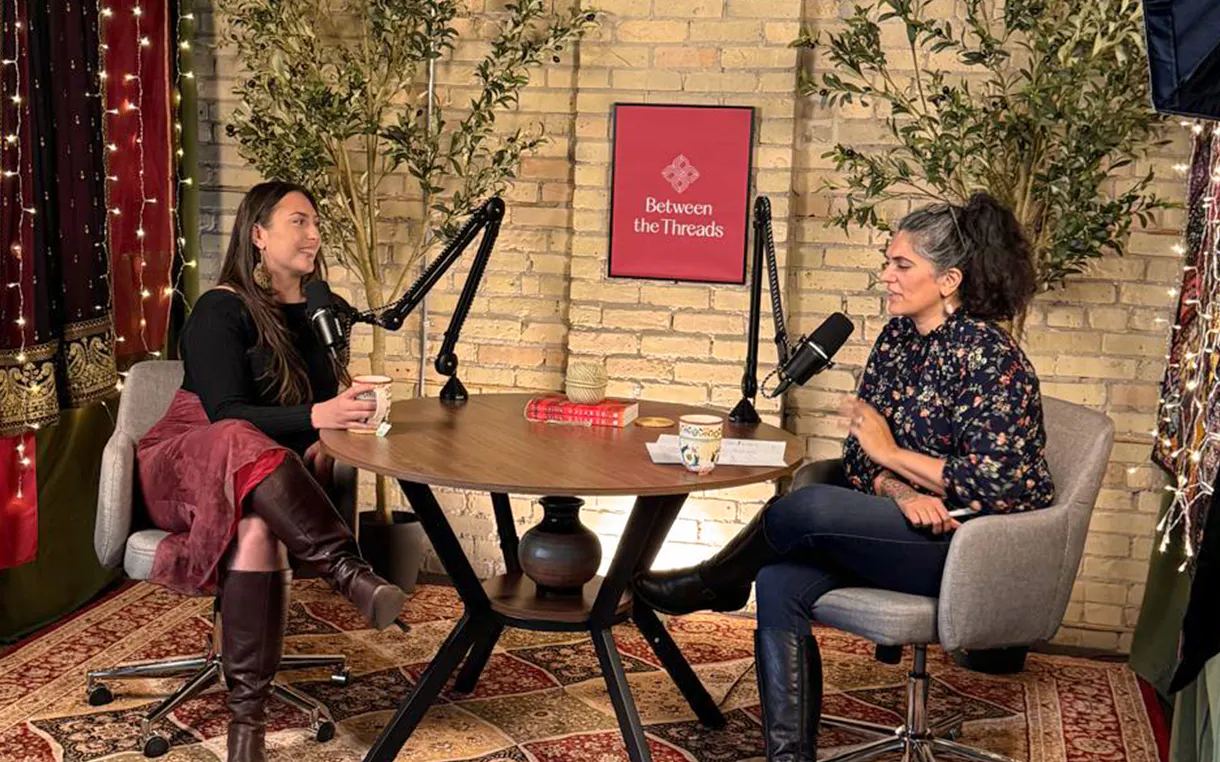
Our set is cozy as heck! There’s a plush carpet, rich colours, warm lighting, comfortable seating, and an array of tea, snacks, toiletries, and mirrors. The experience of being a guest starts long before someone answers their first question.
Spaces communicate things before we ever do. They can make us feel rushed, watched, or uncomfortable, or they can be what makes us feel welcome, curious, and cared for. That idea shows up in Narratives’ work with places and engagement, and Kahanee’s work in creating spaces for dialogue. If we want people to trust us with their stories, we have to think about the environment we invite them into.
Sometimes, listening to stories starts with making someone a cup of tea.
5. We Don't Need Tidy Endings
Peacebuilding isn't always tidy. Neither is planning, identity, belonging, conflict, cities, relationships, or really anything else you can have a good conversation about. So, we don't expect a podcast episode to solve them or untangle the mess.
Sometimes, the most meaningful conversation doesn't end with an answer: it ends with a better question, a perspective you hadn't considered, or something that follows you around for the next few days. And maybe that is the difference between storytelling and storylistening.
Stories don't create connection simply because they are told. Someone has to make room for them. Someone has to ask the questions. Someone has to listen without already deciding what the answer should be. Someone has to be willing to sit in the grey.
The microphones help, but that's not really where the work happens.